Pipeline

Advancing Allosteric Therapeutics to Change the Treatment Paradigm

At Atavistik Bio, we are developing a pipeline of transformative allosteric therapeutics to address serious unmet patient needs. Our AMPS™ platform has enabled us to efficiently deliver best-in-class small molecule allosteric inhibitors for high value targets, with an internal focus on rare hematology.

 

Program/Target Indication
Discovery Lead Optimization IND Enabling Clinical STAGE
 
ATV-1601
AKT1
HHT and Vascular Malformations
Stage - Clinical
ATV-1601 is an oral allosteric inhibitor that selectively inhibits AKT1, with the potential to be disease-modifying and efficacious across ALK1, ENG, and SMAD4 mutations in HHT.

HHT-Harmony Study (NCT07601425) is a Phase 1/2 proof-of-concept study that will evaluate the safety and efficacy of ATV-1601 for individuals with moderate to severe HHT.
Program 2
JAK2V617F
Myeloproliferative neoplasms
Stage - Lead Optimization
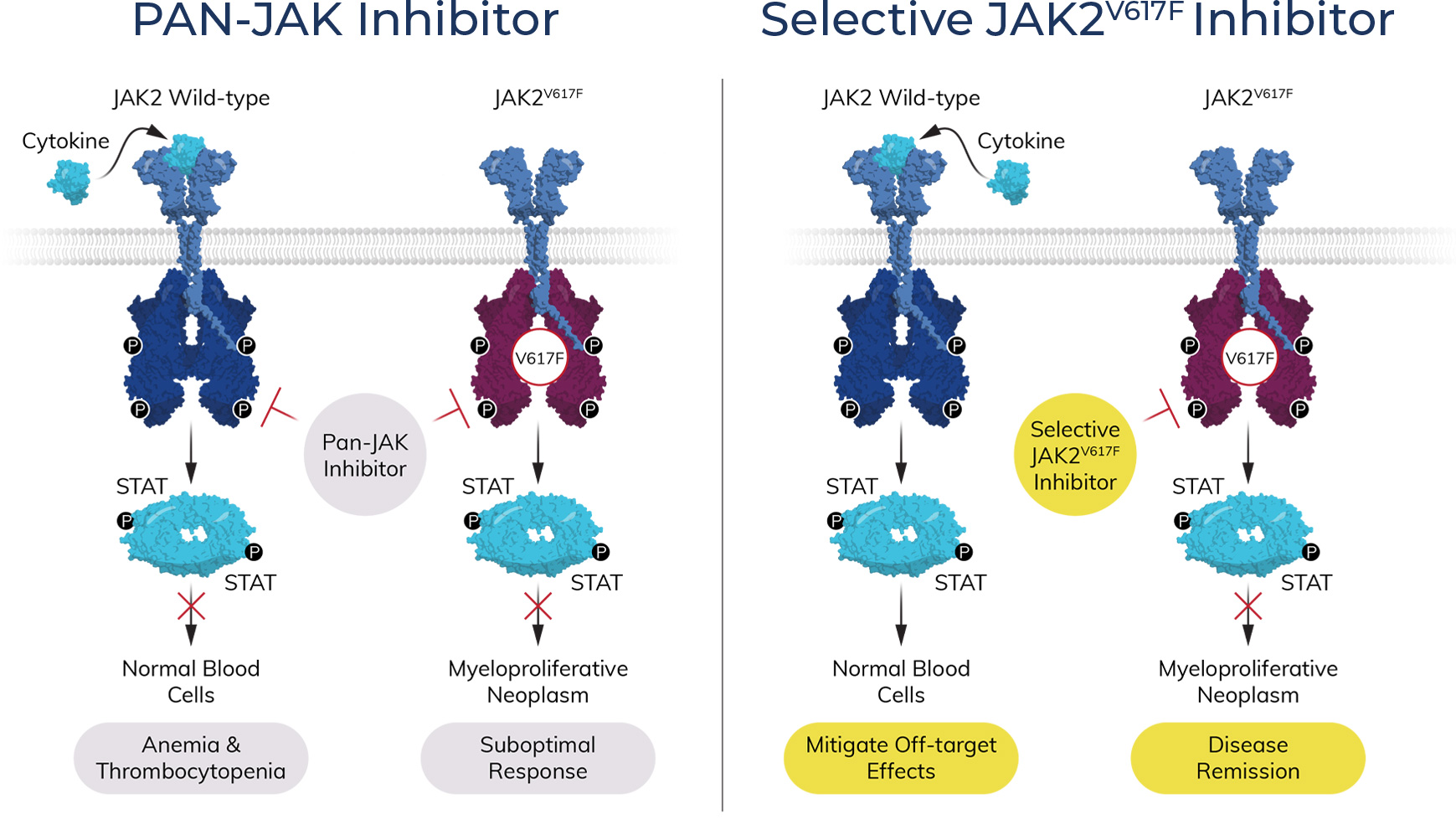
Atavistik Bio has discovered novel allosteric JAK2V617F selective inhibitors that suppress mutant-dependent signaling while sparing wild-type JAK2. Compounds with favorable PK properties and tolerability are being advanced for further development. These candidates have the potential to address the significant unmet needs of patients with MPNs by providing disease-modifying efficacy while avoiding off-target hematological effects associated with wild-type JAK inhibition.
Metabolic Disease
Program 4
Undisclosed
Hepatic Encephalopathy
Stage - Lead Optimization
Partnerships
Partner: Pfizer
Undisclosed
Oncology
Stage - Discovery

Hereditary Hemorrhagic Telangiectasia (HHT)

Hereditary Hemorrhagic Telangiectasia (HHT) is a severe, multi-organ disease with significant morbidity and mortality driven by epistaxis, anemia, and complications of visceral AVMs. It is the second most common inherited bleeding disorder, affecting more than 80,000 people in the US and 1.6 million people globally, with no approved therapies currently available.

For patients, their day to day is encumbered by chronic bleeding that limits their quality of life and independence. It also means they are more likely to need surgical or ablative interventions to help control bleeding and many also require blood transfusions and iron infusions to address the anemia. Management of the disease and complications requires a multidisciplinary team which adds a significant burden to patients over the course of their lifetime.

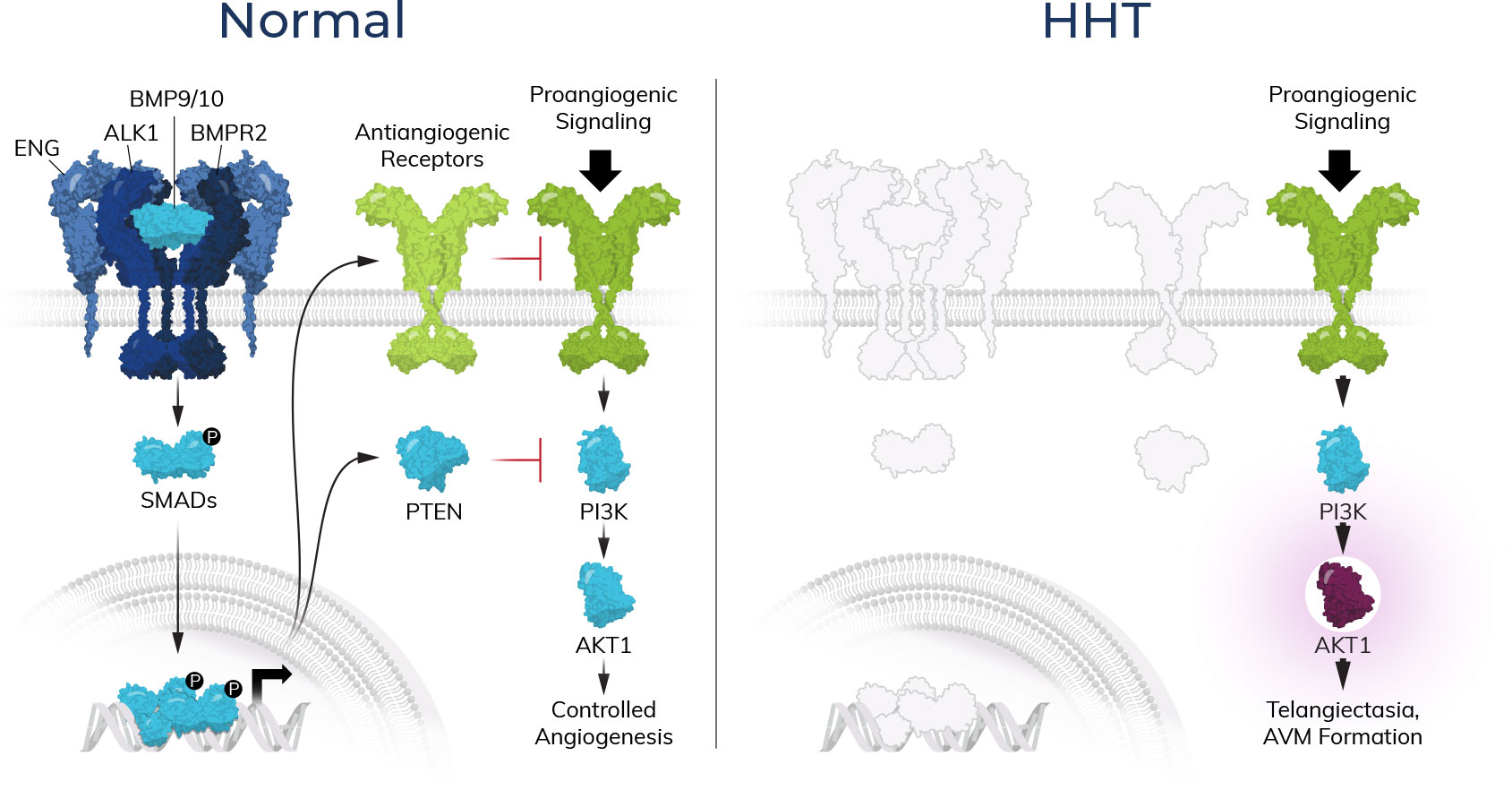
HHT is a ​genetically inherited disease caused by loss-of-function mutations in ENG, ALK1 and SMAD4 resulting in malformed blood vessels that can affect multiple organ systems throughout the body including the liver, lungs, gastrointestinal tract, and brain. Hyperactivation of the AKT1 pathway is a hallmark of the disease which results in the formation of abnormal blood vessels (AVMs) that rupture or cause abnormal blood flow and lead to chronic bleeding, anemia, organ damage, and for some, life-threatening complications.

Selectively inhibiting AKT1, the primary AKT isoform and driver of abnormal endothelial growth implicated in HHT, offers a novel and potentially disease-modifying therapeutic approach for this chronic bleeding disorder complicated by multiorgan involvement.

Pathway in HHT diagram
Selective allosteric inhibition of AKT1 offers potentially disease-modifying therapeutic approach to normalize abnormal angiogenesis

ATV-1601 is an oral allosteric inhibitor that selectively inhibits AKT1, with the potential to be disease-modifying and efficacious across ALK1, ENG, and SMAD4 mutations, while delivering meaningful epistaxis control and a well-tolerated profile for patients.

Harmony-HHT Study

This is a Phase 1/2 study evaluating the safety and efficacy of ATV-1601 and determining if it can help improve symptoms and potentially impact the underlying disease for individuals with moderate to severe Hereditary Hemorrhagic Telangiectasia (HHT).

For patients or caregivers to learn more about the study, please visit our trial site Harmony-HHT Study


Harmony-HHT

Study sites are currently enrolling patients.

Please contact StudyDirector@atavistikbio.com for more information


Myeloproliferative neoplasms (MPNs)

Myeloproliferative neoplasms (MPNs) are a group of chronic blood cancers characterized by the overproduction of mature blood cells in the bone marrow, leading to significant morbidity and mortality driven by thrombotic events, bleeding complications, progressive marrow dysfunction, and risk of transformation into acute myeloid leukemia. The major subtypes – polycythemia vera, essential thrombocythemia, and myelofibrosis – collectively affect more than 300,000 people in the US.

The JAK2V617F mutation is the most common driver mutation in patients living with MPNs, affecting approximately 95% of patients with polycythemia vera (PV), 60% of patients with essential thrombocythemia (ET) and 55% of patients with myelofibrosis (MF). Selectively targeting JAK2V617F has the potential to reduce mutant allele burden, preserve normal bone marrow function, and have a disease modifying impact that could substantially improve long term outcomes and quality of life for patients with MPNs.

jak2_diagram in HHT diagram
Selective allosteric inhibition of JAK2V617F has the potential to generate more durable responses and mitigate off-target hematological effects